Originally published by Monocle
As the gates of theVenice Biennaleopen to the public today, the heavy doors of the Russian pavilion will close. The substantial security contingent pacing around the building’s perimeter was kept busy by protesters voicing their opposition to both Russia and Israel’s inclusion in this year’s festival.
On Wednesday, with hot pink balaclavas and even hotter fuchsia flares in tow, the art collective Pussy Riot’s chanting forced the Russian pavilion to temporarily close its doors. By the end of Vernissage – the preview week for press and VIPs – an impeccably dressed lone woman stood outside in a fedora, sunglasses and striking checked suit. But it wasn’t her style that kept a steady stream of smartphones and television-news cameras pointed in her direction. On her back was a sign that read: “NO PUTIN NO WAR”. The bright blue Birkin swinging idly from her arm was emblazoned with a crossed-out illustration of the Russian leader’s face.
Elsewhere, Latvia’s pavilion (as it happens,an underrated gem of an exhibitionin the Arsenale) launched a campaign titled “Death in Venice”. The Latvians are calling on visitors to print a specially designed graphic to show their opposition to Russia’s presence when heading to the Biennale. The campaign will run until November and signals that those ardently opposed to Russia’s pavilion don’t want their voices to fade as the press and VIPs vacate the city after Vernissage.
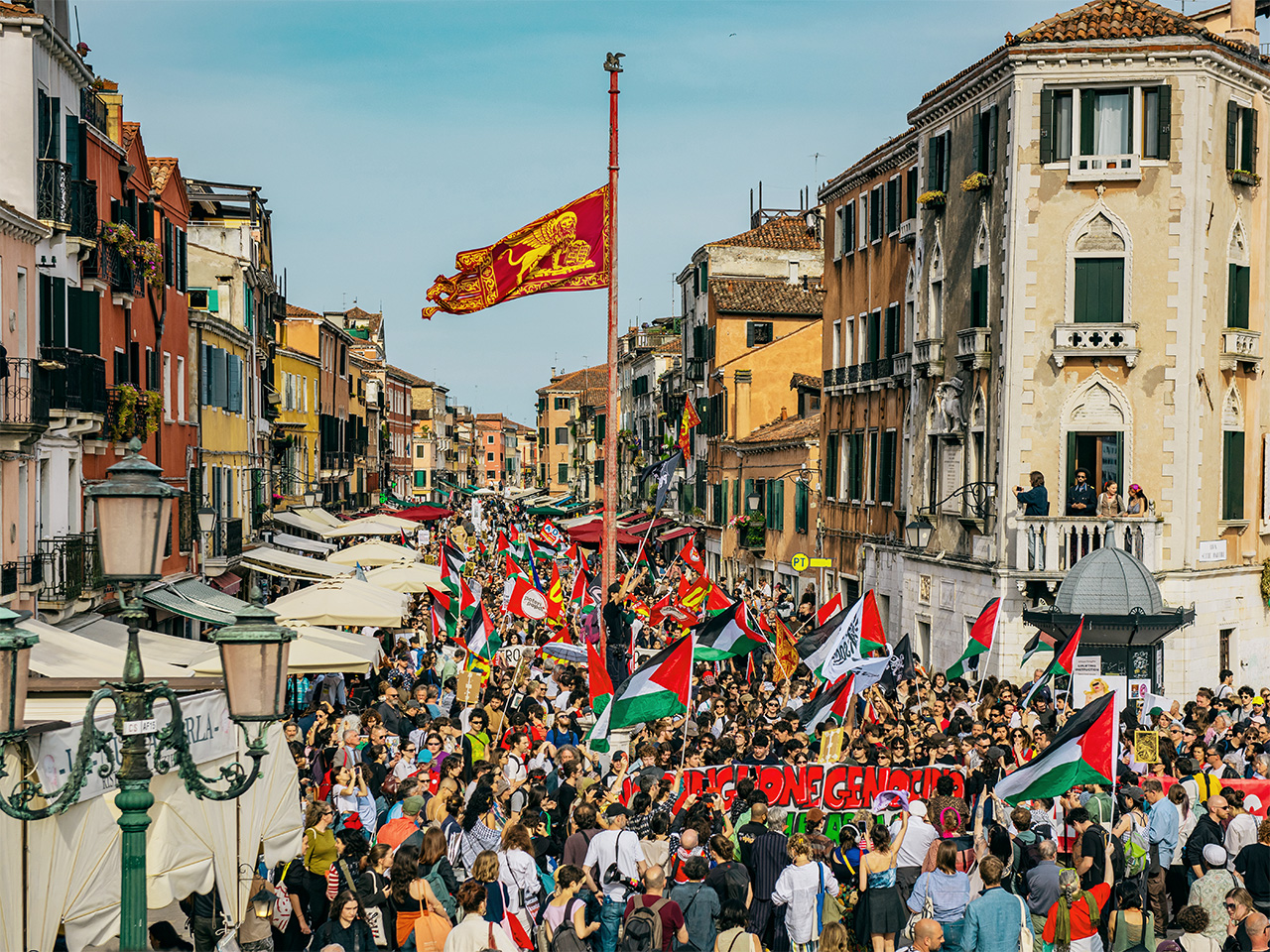
On Friday, many visitors eagerly flocking to see this year’s most talked about pavilion were disappointed to find it closed all day. Austria’s exhibit is a performance featuring full nudity, bodily fluids and, just outside the pavilion doors, a topless woman who dangles from inside a giant bell. The lack of a naked female bell clapper was just one symptom of a 24-hour strike led by the Art Not Genocide Alliance group (Anga), which has shut down multiple national pavilions and included a rally by the Arsenale. The action was a response to the inclusion of Israel’s pavilion this year (albeit moved from its enviable spot in the Giardini to a less prestigious location elsewhere). While politics and art go hand in hand, this kind of demonstration is unprecedented in the Biennale’s recent history.
The controversy has been coming to a boil for some time. Before Vernissage even began, a decision was made to replace the event’s Golden and Silver Lion awards with a Eurovision-style public vote in November. And then just days before the gates opened,the entire Biennale jury resigned over the pavilions.
Understandably, the art itself has been excluded from much coverage of this week – compounded by a lack of prizes not creating the usual buzz over certain pavilions. The Biennale’s late curator, Koyo Kouoh, titled this year’s event “In Minor Keys”: her curatorial vision is all about subtlety, slowing down and tuning into quieter, more elusive signals. Instead, with the decision to include such contentious national pavilions, the Biennale administration has ensured that this Vernissage was dominated big statements and loud protests.
As an Amazon Associate, we earn from qualifying purchases at no extra cost to you.