Originally published by Monocle
JapanWhile there might be few children elsewhere in the Giardini, Japan’s pavilion boasts roughly 200 babies. The dolls are hanging from the ceiling, creeping around fire extinguishers and roaming the pavilion’s perimeters. There’s even one peering down from the roof of the building. Visitors are invited to pick up and hold the weighted dolls or to even “change their diapers” (revealing a hidden QR code that leads to a poem). “The dolls weigh 5.5kg,” says artist Ei Arakawa-Nash. “It’s much heavier than you might expect, so usually people instantly smile and their facial expression softens. Until the show opened, I couldn’t have anticipated that.” The co-created performance is undoubtedly a strange one but it’s surprising how many who take part appear comforted by carrying around a doll. The result is tender and unexpectedly moving.
The Japanese pavilion(Image: Uli Holz)1 / 4
The Japanese pavilion(Image: Uli Holz)2 / 4
Artist EI Arakawa-Nash3 / 4
The Japanese pavilion(Image: Uli Holz)4 / 4
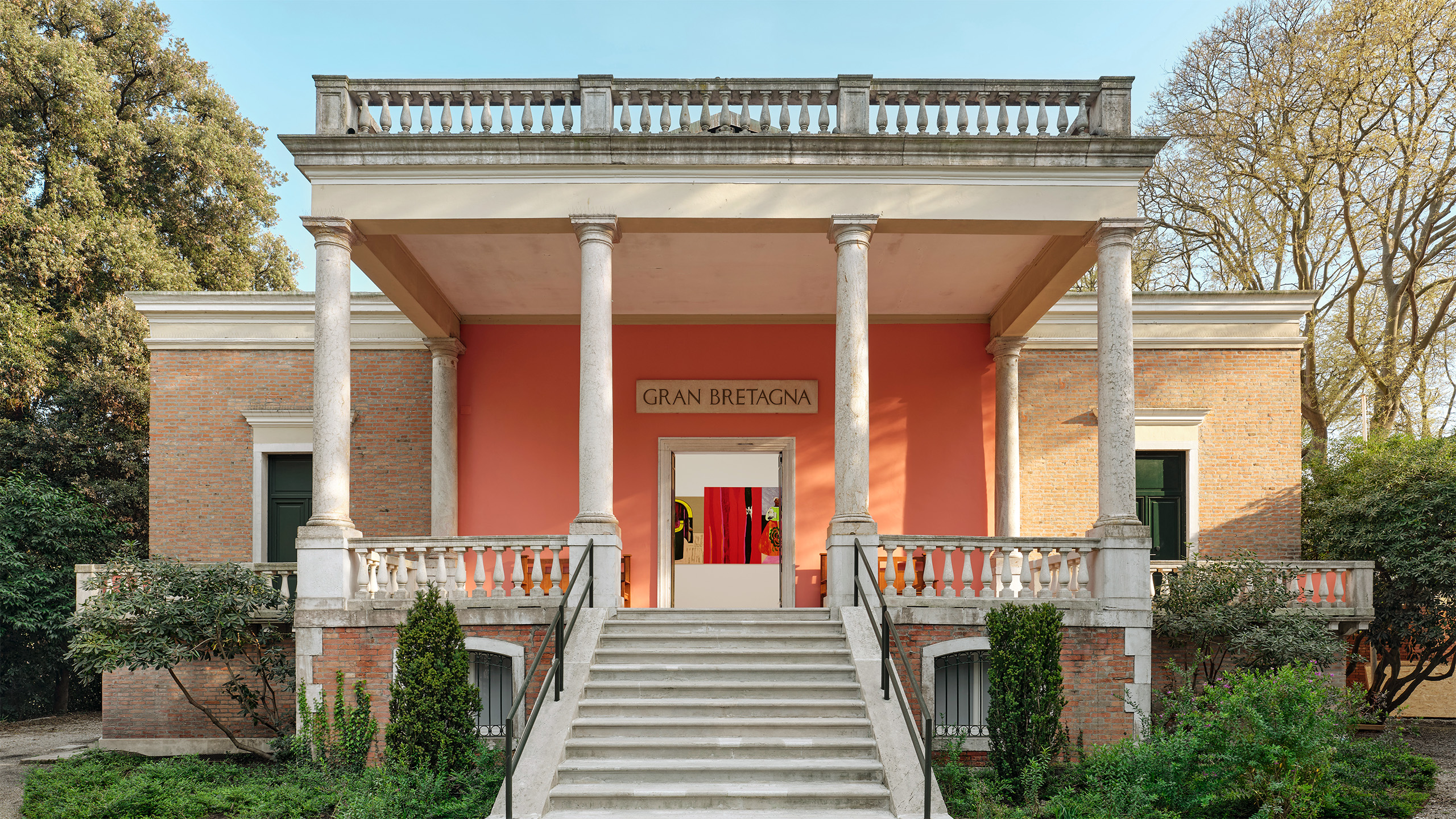
Great BritainOn entering the British pavilion, a soundscape transports visitors to an idyllic summer’s day in the countryside. Equally transportive are the paintings by this year’s artist chosen by the British Council, Lubaina Himid. Bright colours dominate the bold works that sometimes stretch across multiple canvases and depict vocational scenes of architects, tailors and chefs at work. While the soundscape (“of one of those ‘lovely day days’” in the words of Himid) and cheerful hues suggest a sunny outlook, on closer inspection there is a more complicated message about migration and assimilation. “Visitors come to any showing space with their own experience in their pockets,” Himid tells Monocle. “Me and my team are presenting something that is, in a sense, an imagined Britain. The visitors and the people in the paintings are trying to work out how you make sense of finding yourself in a place that seems welcoming – bright and full of promise – but isn’t your home.”
The British pavilion1 / 4
Tailors at work(Image: Eva Herzog)2 / 4
Associate curator Ese Onojeruo, artist Lubaina Himid and Commissioner of the British Pavilion, Emma Dexter(Image: Eva Herzog)3 / 4
SyriaThe benefit of not having a pavilion in the Giardini or Arsenale is that it can give artists the opportunity to build something new. Syria’s Biennale representative, Sara Shamma, has recreated the tower tombs from the ancient city of Palmyra in Venice’s Dorsoduro district. The tombs were built between the 1st and 3rd centuries and destroyed in 2015. Inside Shamma’s ode to them is a tight yet thoughtful exhibition that combines paintings with a soundscape and scent created by historic perfume makers in Damascus. “We are witnessing the establishment of this new Syria,” Shamma tells Monocle. “And Syrians themselves now can participate in building this country. The pavilion is not just about what’s been lost, it’s really about a new beginning and a hopeful future.”
Syria’s Biennale representative, Sara Shamma(Image: Courtesy of Sara Shamma)1 / 3
Inside the Syrian pavilion(Image: Courtesy of Sara Shamma)2 / 3
The Syrian pavilion(Image: Courtesy of Sara Shamma)3 / 3
LatviaThis underrated yet intriguing pavilion in the Arsenale is a treat for anyone with an interest in fashion history. Here sculptures by artist duo Mareunrol’s bend and distort the paraphernalia of getting dressed. Garment bags and rucksacks are shaped into new, unexpected forms, while shiny rails and hangers come alive as they twist and intertwine with delicate bird sculptures. The presentation is combined with archival footage from the Untamed Fashion Assembly (UFA), founded by artist Bruno Birmanis. Between 1990 and 1999, the UFA held festivals of fashion, art and performance in Latvia. The films and stills on display in Venice document the rise of young Baltic designers in a time of both great artistic creativity and tumultuous politics. While the exhibition is memorable, Latvia has also made its mark on the Biennale by leading the “Death in Venice” campaign, which encourages visitors to show their opposition to Russia’s inclusion in the event.
Mareunrol’s (left, centre) and Bruno Birmanis (right) at the Latvian pavilion(Image: Kristine Madjare)1 / 3
(Image: Kristine Madjare)2 / 3
(Image: Kristine Madjare)3 / 3
AustraliaIt has been a particularly long road from Sydney to Venice for Australia’s artist representative Khaled Sabsabi. After being awarded the commission, it was rescinded last year because of criticism over early works celebrating Hassan Nasrallah, the former Hezbollah chief who was assassinated by Israel in 2024. The commission was later reinstated. Now he has a rare presence in both the Giardini and Arsenale with two installations of large-scale digitised paintings that slowly move and change colour as you stand in front of them. Calming and contemplative, the exhibits create a soothing space away from the bustle of the Biennale. “Both works were made at the same time,” Sabsabi tells Monocle. “They come from the same well of creativity. They have a direct relationship with each other in terms of philosophies connected to Sufism. It is about better understanding oneself and dispersing that upon humanity, collectively, regardless of ethnicity, faith, culture or time, so that it’s an open invitation to all.”
Australian pavilion, ‘conference of one’s self’(Image: Andrea Rossetti)1 / 3
Australian pavilion, ‘conference of one’s self’(Image: Andrea Rossetti)2 / 3
Artist Khaled Sabsabi (left) and curator Michael Dagostino(Image: Andrea Rossetti)3 / 3
As an Amazon Associate, we earn from qualifying purchases at no extra cost to you.