Originally published by Monocle
1.The rooftop playgroundOnebite Design Studio
This new rooftop space in Tin Shui Wai, a satellite town in northwesternHong Kong, was designed by Onebite Design Studio as a response to urban density. The firm’s research into the New Territories precinct found that the open space per person in the north of Tin Shui Wai was less than 1 sq m, falling far short of the government’s 3.5 sq m benchmark.
The squeeze forced Alan Cheung, the managing director and co-founder of Onebite, to rethink a car park in T Town shopping mall. “We wanted this rooftop to be a space that people can claim as their own,” he says of The Wonderful Town of Play.
Onebite’s Alan Cheung and Vivian Tsoi1 / 2
The Wonderful Town of Play2 / 2
Inspired by the popular Hong Kong Wetland Park, Cheung’s team created a 32,000 sq ft playground with nine attractions. Climbing frames and rides are paired with artworks of wetland fauna and information panels on native species, to educate and entertain the residents.
While the treehouse-inspired slides and five-metre-high adventure tower are the playground’s most striking elements, it’s the vivid floor artwork that binds the project together. “In contrast to tall attractions, which activate high-energy group play, the on-ground graphics enable the young ones to carve out spaces when they feel tired,” says Vivian Tsoi, Onebite’s landscape designer.
“We also took the parents and grandparents into consideration because they are the ones who take the kids here,” she adds. In addition to the play equipment, there are several seats for adults to oversee their toddlers, offering them both respite and peace of mind.
A range of people were present when Monocle visited on a midweek morning, from grandparents to teenage couples on the merry-go-round and, of course, young children having fun, oblivious to the thought that went into the playground.onebitedesign.com
2.The peerless pierNew Office Works
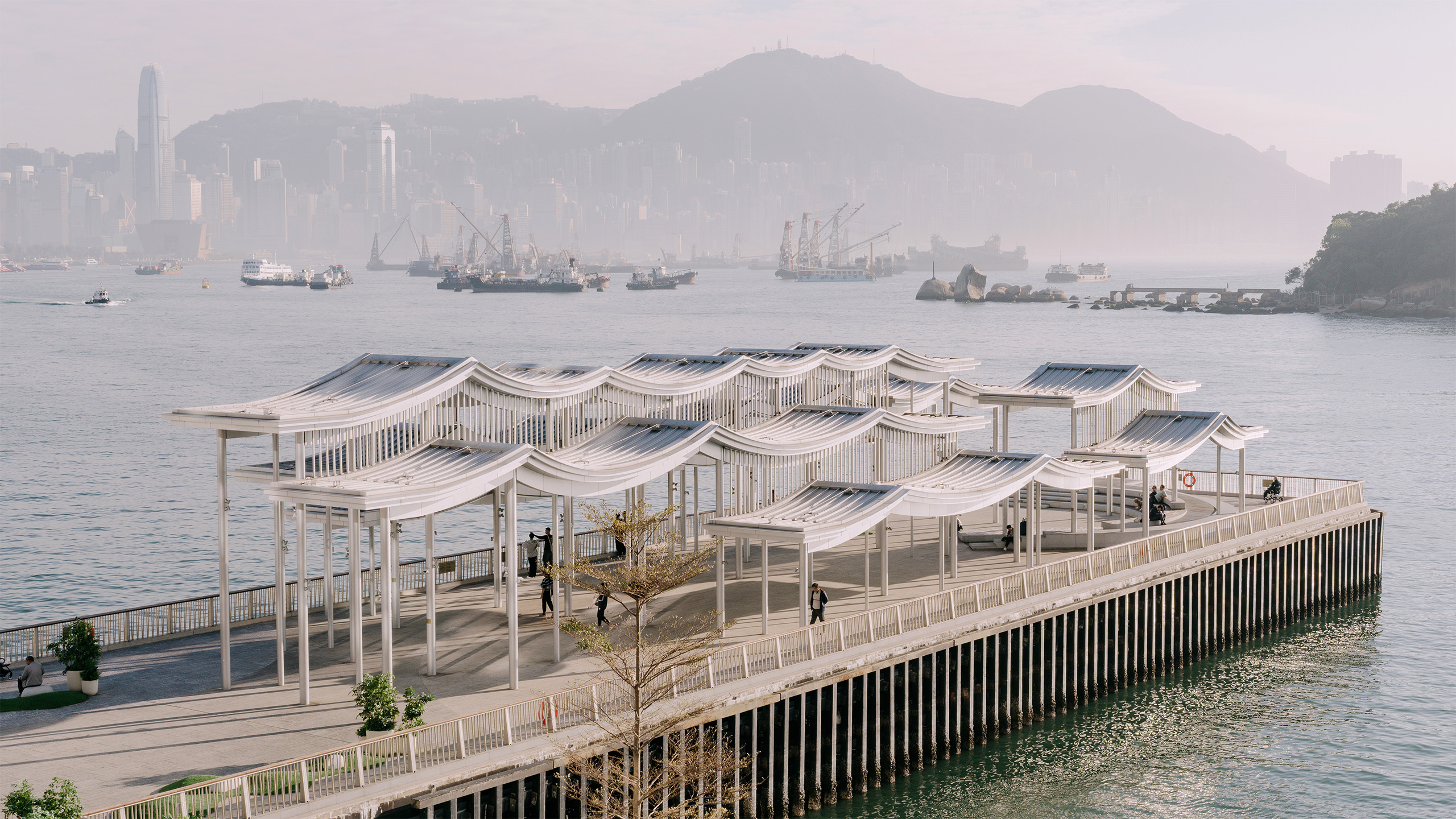
A disused pier on the Kowloon Peninsula has beenturned into a social space for residentsby Hong Kong architects New Office Works. Once a weathered slab of concrete used for offloading cargo, it is now packed with people, even on weekdays. When Monocle stops by Townplace Pier, there are children playing, people fishing and couples watching the sun dip below the horizon.
Five ribbons of wave-like patterns create the canopy, which is supported by slender columns, giving the pier the look of a fishing village. Despite its size, it has an airy quality. “The pavilion sits on an existing structure, so we wanted to put something delicate on top,” says New Office Works’ co-founder Evelyn Ting. Some parts are covered to shelter people from the sunlight and rain, while others are exposed to the elements, creating patterns of light and shadow.
At first glance, the pavilion seems simple, but there is poetry to the construction – a trait that has come to define the firm’s projects. The steel columns mirror the material that is used to make ships, while the satin aluminium panels act as reflective ceilings. The columns double as pipes to channel rainwater. Even the austere-looking tiles are composed of four irregular shapes that complement the undulating roof.
“We see architecture as a language with which you can communicate in either a straightforward or subjective manner,” says Paul Tse, New Office Works’ other co-founder. “Through the interplay of structural forms and materials, we hope to create spatial conditions that can be interpreted in different ways and, ultimately, move people.”newofficeworks.com
Further reading:Hong Kong’s new 13km promenade is revitalising community life and wellbeing
3.The international outpostSnøhetta
“It took a long process to find our new home,” says Snøhetta’s managing director for Asia, Richard Wood. “We wanted a space that was large enough for us all to be in one space while maintaining street access.”
Since putting down roots in 2018, the Oslo architecture practice’s Hong Kong outpost has continued to scale new heights, chalking up a number of high-profile projects including the forthcoming Shanghai Grand Opera House and the Shibuya Upper West Project in Tokyo. To reflect this growth, Snøhetta’s Hong Kong studio recently moved into a larger office in Sai Ying Pun.
Reading zone in Snøhetta’s Hong Kong office1 / 3
Rust-coloured pantry inspired by the colours of Hong Kong and Norway2 / 3
Snøhetta’s managing director for Asia, Richard Good, and team3 / 3
The L-shaped space features a large communal table for meals and meetings. To remove any obstacles to team building, everyone is assigned a new seat every year, cultivating a sense of community.
Flexibility matters too. Retractable partitions accommodate changing needs, from team huddles to exhibitions. “We don’t just show clients the final project,” says Wood. “We bring them into our office to create.”
Another defining office feature is its street-level entrance. By embracing the landscape, the hum of Hong Kong acts as a reminder of the team’s civic responsibility as architects. “We loosen up when we’re connected to the city. Buildings are meant to be used by people, which is why our office invites the neighbourhood in.”snohetta.com
This article is from Monocle’s newspaperThe Hong Kong Correspondent, which isavailable to purchase now. In its pages we meet the entrepreneurs going against the grain, survey fresh projects that are reshaping Central and give you a taste of what the fashionable Hong Konger is wearing about town. Plus: Monocle’s favourite places to eat, drink and be merry.Purchase your copy today.
As an Amazon Associate, we earn from qualifying purchases at no extra cost to you.